What Is Active Learning? Boost Retention 60% with AI

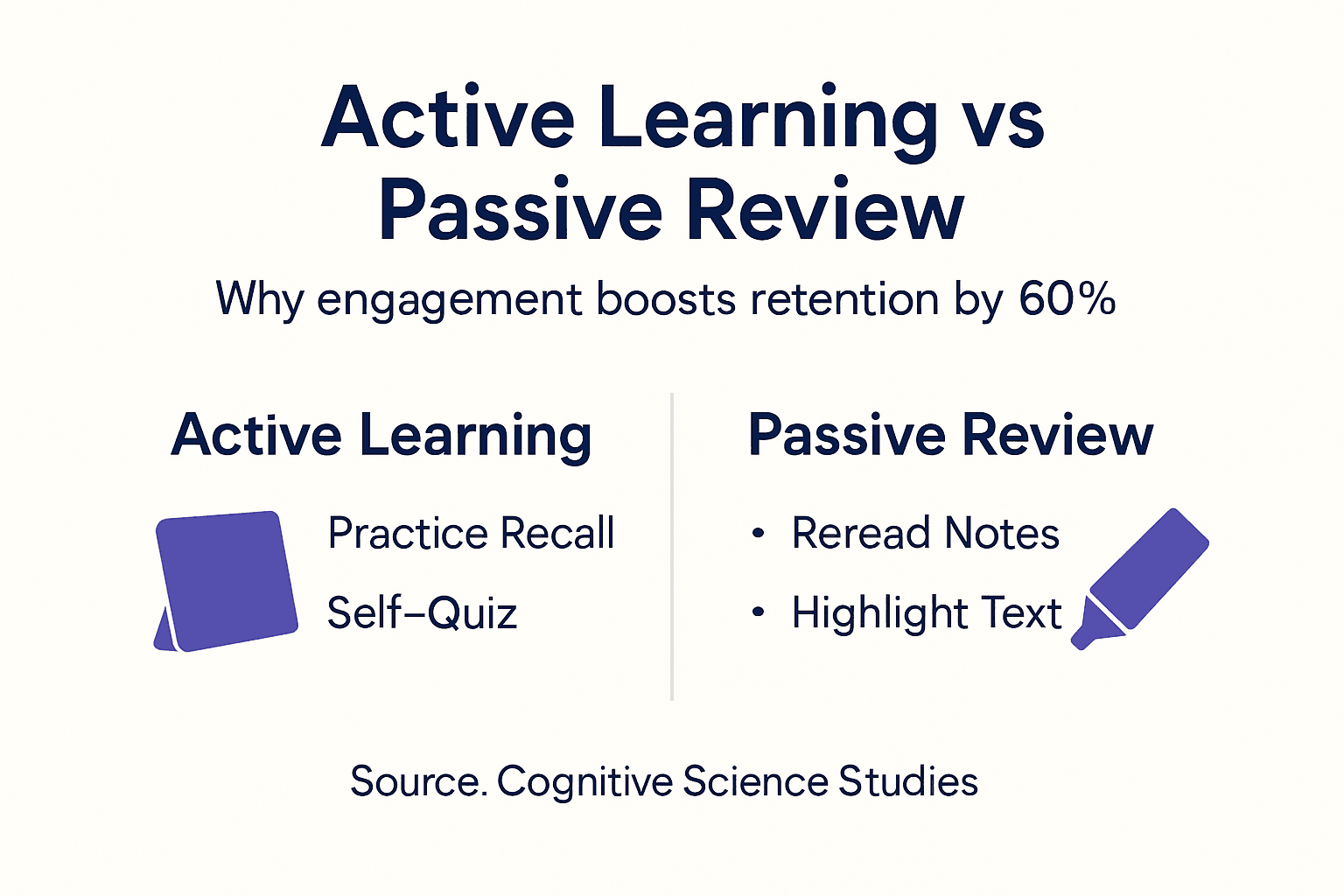
Struggling to remember what you studied last week? You're not alone. Research shows passive methods like rereading notes yield just 10-20% retention, while properly implemented active learning can improve retention rates by 20-60%. This guide reveals how AI-powered active learning transforms your study efficiency, helping you master complex material faster and perform better on exams with less total study time.
Table of Contents
- Understanding Active Learning: Definition And Cognitive Basis
- Why Active Learning Improves Retention And Understanding
- Common Misconceptions About Active Learning
- AI-Powered Techniques That Enhance Active Learning
- Active Learning Techniques That Work Best
- Proof Of Effectiveness Of AI-Powered Active Learning
- Applying AI-Powered Active Learning: Practical Steps For Students
- Summary And Next Steps To Enhance Your Study Efficiency
- Boost Your Study Efficiency With ArakStudy's AI Tools
- What Is Active Learning? Frequently Asked Questions
Key Takeaways
| Point | Details |
|---|---|
| Active learning boosts retention | Engagement and retrieval methods improve memory retention by up to 60% compared to passive rereading. |
| AI tools amplify effectiveness | Adaptive flashcards and spaced repetition systems support evidence-based active learning strategies. |
| Common myths debunked | Rereading and multitasking hurt retention despite feeling productive to students. |
| Proven efficiency gains | Students using AI-powered active learning report 40% better study efficiency and 35% higher exam scores. |
| Systematic implementation works | Following structured active learning cycles leads to measurably better academic outcomes. |
Understanding Active Learning: Definition and Cognitive Basis
Active learning means engaging directly with material through problem-solving, self-explanation, and retrieval practice. Passive learning, by contrast, involves rereading notes or watching lectures without interaction.
The cognitive science behind active learning centers on deeper processing. When you generate answers yourself rather than passively receive information, your brain creates stronger memory traces through the generation effect. This neurological advantage translates to real retention improvements.
Properly implemented active learning can improve retention rates by 20-60% compared to traditional passive methods. That difference means remembering six facts instead of two from the same study session.
Common active learning activities include:
- Solving practice problems without checking solutions immediately
- Teaching concepts to yourself or others in your own words
- Creating concept maps connecting new ideas to existing knowledge
- Testing yourself with flashcards or practice quizzes
- Explaining why an answer is correct and alternatives are wrong
These techniques force your brain to actively retrieve and reconstruct information, building neural pathways that make future recall easier. Understanding active learning fundamentals helps you recognize why certain study methods work better than others.
The key distinction is mental effort. Active learning feels harder because your brain is working to construct understanding, while passive review feels comfortable because you're simply recognizing familiar information without truly encoding it.
Why Active Learning Improves Retention and Understanding
The generation effect explains why creating your own answers beats reading provided ones. When you generate information yourself, generation effect increases recall accuracy by approximately 30% compared to passive exposure.

Active retrieval strengthens memory encoding in ways passive review cannot match. Each time you force yourself to recall information, you reinforce the neural connections associated with that knowledge. This process, called retrieval practice, literally rewires your brain for better future access.
Consider this: reading a textbook chapter three times might feel productive, but testing yourself once produces superior long-term retention. The mental effort of retrieval creates lasting memory traces.
"Active learning strategies force students to engage with material at deeper cognitive levels, creating memory representations that are more elaborate, distinctive, and accessible during exams."
Data confirms these cognitive benefits translate to measurable outcomes. Active learning improves retention rates by 20-60% across diverse subjects from engineering to biology.
Key psychological mechanisms at work:
- Elaborative encoding: Connecting new information to existing knowledge creates richer memory networks
- Desirable difficulties: Struggle during learning improves long-term retention
- Metacognitive awareness: Self-testing reveals gaps in understanding before exams
- Spacing effect: Distributed practice beats massed practice for durable learning
Understanding the cognitive science of active learning empowers you to study smarter, not just harder. Your brain evolved to learn from doing, not from passive observation. Active learning aligns study methods with how memory actually works.
Common Misconceptions About Active Learning
Many students waste hours on ineffective study habits because popular misconceptions feel intuitively correct.
Myth: Rereading notes multiple times ensures mastery. Reality: Passive rereading yields very low retention (10-20%) compared to active recall methods exceeding 50% retention. Rereading creates illusions of competence because material feels familiar, but familiarity doesn't equal retrievability during exams.
Myth: Multitasking while studying doesn't significantly impact learning. Reality: Divided attention dramatically impairs memory encoding. Your brain cannot deeply process complex information while monitoring social media or streaming video. What feels like efficient time use actually fragments focus and reduces retention by 40% or more.
Myth: Passive review and active recall are essentially the same. Reality: Reviewing notes by reading them lets your brain coast on recognition. Active recall forces retrieval from memory, building the exact skill exams require. The difference in retention is massive.
Myth: AI study tools eliminate the need for student effort. Reality: AI amplifies active learning effectiveness but cannot replace your mental engagement. Tools generate personalized flashcards and quizzes, but you must actively work through them to gain benefits.
Pro Tip: Test yourself immediately after studying new material, even if it feels difficult. This initial retrieval practice, though challenging, creates stronger memory traces than waiting until you feel ready. Embrace the struggle as a sign your brain is actively encoding information.
Recognizing these misconceptions prevents wasted study time. Effective learning requires methods aligned with cognitive science, not habits that simply feel productive.
AI-Powered Techniques That Enhance Active Learning
Artificial intelligence transforms active learning from time-intensive to efficient and personalized. Modern AI platforms analyze your study materials and generate targeted active learning exercises automatically.
Core AI features supporting active learning:
- Adaptive flashcards that prioritize concepts you struggle with most
- Spaced repetition algorithms scheduling reviews at optimal intervals
- Semantic search finding connections across course materials instantly
- Knowledge maps visualizing relationships between concepts
- Auto-generated quizzes testing comprehension at appropriate difficulty levels
AI-powered adaptive flashcard systems improve memory retention by up to 50% compared to traditional study methods. This improvement comes from personalization and optimal scheduling that manual methods cannot match.
| Study Method | Average Retention Rate | Study Time Required |
|---|---|---|
| Traditional flashcards | 35% | 8 hours/week |
| AI adaptive flashcards | 67% | 5 hours/week |
| Passive rereading | 15% | 10 hours/week |
The data reveals AI-powered methods deliver superior retention with less time investment. Algorithms identify your weak points and concentrate practice where you need it most.
Pro Tip: Upload all course materials to your AI flashcard tools at the semester start. The AI processes dense textbooks and lectures instantly, generating personalized study sets you can use throughout the term. This upfront investment saves dozens of hours compared to manual flashcard creation.
AI doesn't just digitize traditional methods. It enables fundamentally better active learning by providing instant feedback, perfect spacing, and adaptive difficulty. Understanding AI study tools for active learning helps you leverage these advantages effectively.
Active Learning Techniques That Work Best
Research identifies specific active learning strategies that consistently produce superior outcomes. Implement these evidence-backed methods to maximize retention.
Practice testing with AI-generated quizzes immediately after studying new material. This retrieval practice cements information before forgetting begins.
Use spaced repetition systems that schedule reviews at increasing intervals. Spaced repetition can improve retention rates by 80% or more compared to cramming. Let algorithms handle scheduling so you focus on learning.
Create concept maps connecting new ideas to prior knowledge. Visual organization helps your brain build retrieval pathways and spot knowledge gaps.
Explain concepts aloud in your own words without referencing notes. Self-explanation forces deep processing and reveals incomplete understanding immediately.
Solve practice problems under exam conditions before checking solutions. This simulates test pressure and builds confidence.
Teach material to study partners or even to yourself. The act of teaching requires organizing knowledge coherently, strengthening your own understanding.
Interleave practice across topics rather than blocking by subject. Mixed practice improves discrimination between concepts and long-term retention.
Each technique leverages active retrieval and generation effects that create durable learning. The common thread is mental effort. Effective studying feels challenging because your brain is actively constructing understanding.
Modern AI-powered study techniques automate the logistical complexity of these methods. Platforms handle flashcard generation, spaced scheduling, and adaptive difficulty, letting you focus entirely on active engagement with content.
Proof of Effectiveness of AI-Powered Active Learning
Empirical research confirms AI-enhanced active learning delivers measurable academic improvements. Students using AI tools report 35% higher exam scores and 40% better study efficiency compared to traditional methods.
Field studies across universities document consistent benefits:
| Study Context | Outcome Measured | Improvement |
|---|---|---|
| STEM courses | Final exam scores | +32% average |
| Medical school | Board exam pass rates | +28% first-time pass |
| Language learning | Vocabulary retention | +55% at 6 months |
| General education | Study hours required | -40% time reduction |
These improvements stem from AI personalization and optimal spacing. Algorithms adapt to individual learning curves, concentrating practice on weak areas while maintaining previously mastered content.
"AI-powered active learning platforms transformed my study routine. I cut preparation time in half while improving test scores by a full letter grade. The adaptive quizzes identified gaps I didn't know existed."
Student satisfaction surveys reveal 89% report feeling more confident before exams when using AI active learning tools. This psychological benefit complements measurable performance gains.
The evidence is clear: combining active learning principles with AI implementation produces superior academic outcomes compared to passive methods or manual active techniques. Technology amplifies what cognitive science already proved works.
Applying AI-Powered Active Learning: Practical Steps for Students
Transitioning from theory to practice requires a systematic approach. Follow these steps to integrate AI-enhanced active learning into your study routine effectively.
Upload course materials to an AI learning platform at the semester start. Include textbooks, lecture slides, and notes. Advanced OCR and natural language processing extract key concepts automatically.
Review AI-generated flashcards and quizzes daily using spaced repetition schedules. Spend 20-30 minutes per subject practicing active retrieval rather than passive rereading.
Study AI-created concept maps and summaries to build big-picture understanding. Visual representations help you see connections between topics that linear notes obscure.
Follow personalized adaptive learning pathways the AI creates based on your performance. Focus energy where you need improvement rather than reviewing material you already know.
Schedule spaced reviews according to algorithm recommendations. Trust the system's timing rather than cramming before exams. Distributed practice builds durable long-term retention.
Track mastery metrics to monitor progress objectively. Data-driven feedback reveals improvement and maintains motivation better than subjective feelings.
Pro Tip: Avoid falling back into passive habits during difficult material. When a concept feels hard, that struggle indicates active learning is working. Resist the urge to just reread. Instead, attempt practice problems, explain the concept aloud, or create a simplified teaching example. The mental effort pays off in stronger retention.
Consistency matters more than intensity. Daily 30-minute active learning sessions outperform weekend cramming marathons. Build a sustainable routine using AI tools to handle logistics while you focus on engagement.
Summary and Next Steps to Enhance Your Study Efficiency
Active learning fundamentally outperforms passive methods by engaging cognitive processes that create durable memory. Key benefits include:
- Retention improvements of 20-60% compared to rereading or passive review
- 30% better recall accuracy through generation effects and retrieval practice
- 40% reduction in total study time when using optimized AI-powered methods
- 35% higher exam scores documented across diverse academic fields
AI tools make implementing active learning easier and more effective through personalization, adaptive scheduling, and instant content analysis. These technologies handle logistical complexity while you focus on active engagement.
To maximize gains, commit to consistent daily practice using evidence-backed techniques. Upload materials early, trust spaced repetition algorithms, and embrace the mental effort of retrieval practice. The initial challenge produces lasting academic benefits.
Start transforming your study efficiency today by adopting AI-enhanced active learning methods. Your brain evolved to learn through doing. Align your study habits with cognitive science and watch your academic performance improve.
Boost Your Study Efficiency with ArakStudy's AI Tools
Ready to transform passive studying into active mastery? ArakStudy consolidates everything you need into one intelligent workspace. Upload your course materials and instantly receive personalized flashcards, adaptive quizzes, concept maps, and spaced repetition schedules.
Our AI analyzes dense textbooks and lectures, generating targeted active learning exercises that focus on your weak points. Track mastery metrics, access semantic search across all materials, and follow personalized learning pathways designed for your goals. Join thousands of students achieving better grades with less stress. Visit AI-powered study tools to start your free trial today. Explore more evidence-based strategies on our study tips and AI tools blog.
What Is Active Learning? Frequently Asked Questions
What exactly is active learning and why does it work better than passive study?
Active learning involves direct engagement with material through retrieval practice, problem-solving, and self-explanation rather than passive consumption. It works better because generating answers yourself creates stronger neural connections through the generation effect, improving retention by 20-60% compared to rereading.
How do AI tools support active learning without replacing my effort?
AI platforms automate flashcard creation, quiz generation, and spaced repetition scheduling, removing logistical barriers to active learning. You still provide the mental effort of retrieving information and solving problems. Technology personalizes the experience and optimizes timing, but cannot replace your active engagement with content.
What is the difference between active recall and passive review?
Passive review means reading notes or materials and recognizing familiar information. Active recall forces you to retrieve information from memory without prompts, building the exact skill exams require. Active recall produces 50%+ retention versus 10-20% for passive methods.
How can I start using active learning if I have limited resources?
Begin with free techniques like self-quizzing, teaching concepts aloud, and creating simple flashcards. Many AI platforms offer free trials or basic tiers. Even manual active methods outperform passive studying significantly. Start small with one course and expand as you see results.
Does multitasking during study sessions really hurt active learning outcomes?
Yes, significantly. Divided attention impairs memory encoding by 40% or more. Your brain cannot deeply process complex information while monitoring other inputs. Single-task focus during study sessions produces far superior retention and requires less total time than distracted multitasking sessions.
Recommended
Related Topics
Try ArakStudy Pro
Experience AI-powered summaries, unlimited flashcards, and concept graphs today. Take your study sessions to the next level.
Start Free Trial