Step-by-Step Guide to Mastering Exams for Students

Long study sessions surrounded by noisy roommates and scattered textbooks leave many students wondering why their grades do not reflect their hard work. For those navigating the pressure of American medical boards or British law finals, your environment and study strategy matter as much as raw effort. This guide uncovers how a dedicated study space and active learning methods turn stressful cramming into focused progress, helping you master complex material when every point counts.
Table of Contents
- Step 1: Set Up An Efficient Study Environment
- Step 2: Organize And Analyze Course Materials
- Step 3: Engage With Interactive Study Tools
- Step 4: Track Progress And Verify Mastery
Quick Summary
| Key Point | Explanation |
|---|---|
| 1. Create a dedicated study space | Consistently studying in the same location trains your brain to focus and reduces distractions. |
| 2. Organize materials effectively | Group materials by topic and create study guides to synthesize information and enhance understanding. |
| 3. Use interactive study tools | Engage actively with materials through flashcards, quizzes, and concept maps to boost retention and recall. |
| 4. Track progress regularly | Establish clear goals and log performance to identify strengths and weaknesses in your knowledge. |
| 5. Adjust study plans based on data | Analyze tracking metrics to focus efforts on areas needing improvement and streamline your studying. |
Step 1: Set up an efficient study environment
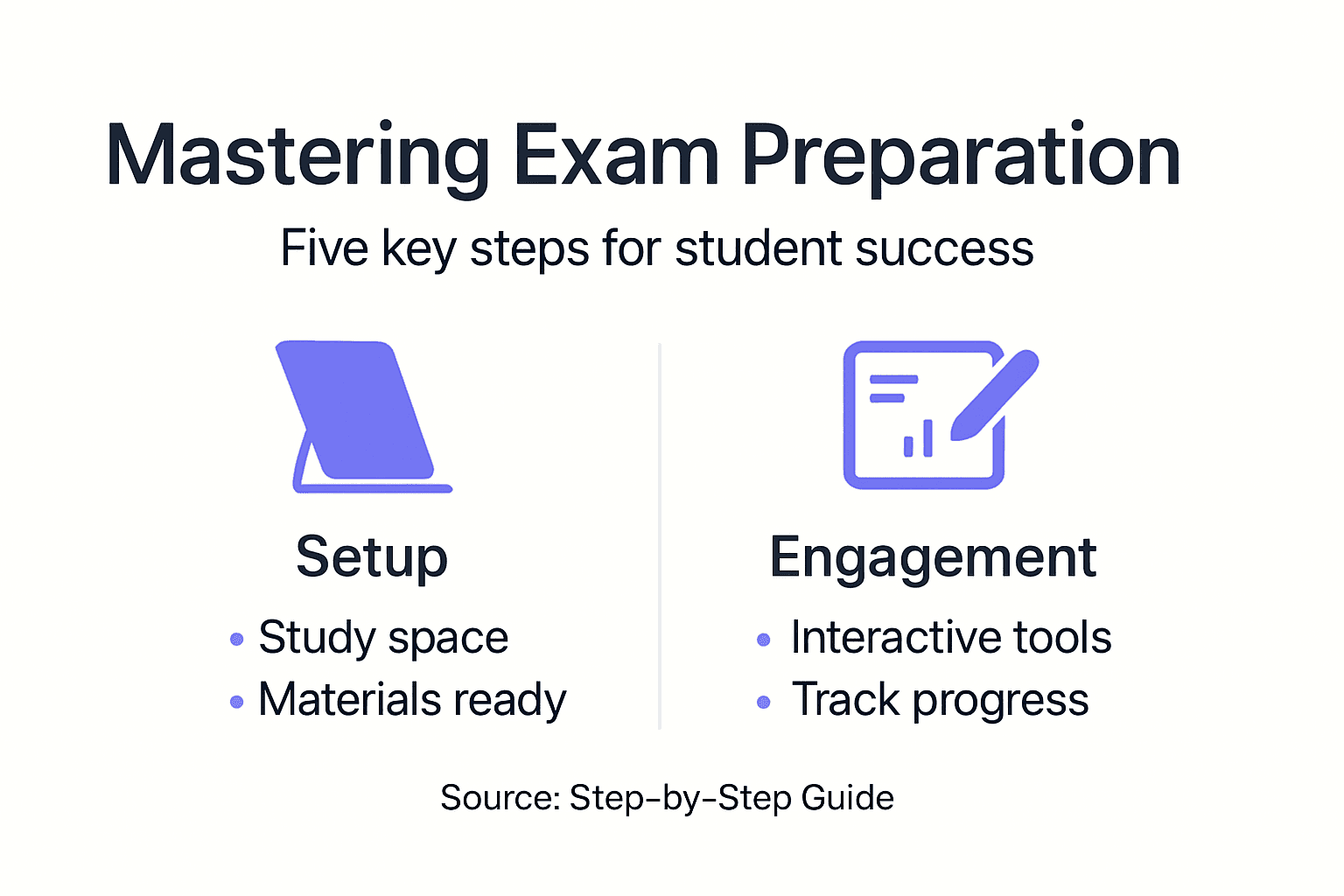
Your physical surroundings have an outsized impact on how well you absorb material. Creating a dedicated study space isn't a luxury—it's a necessity for serious exam prep, especially when you're tackling demanding coursework.
Start by choosing a specific location where you'll consistently study. This could be a desk in your room, a corner of the library, or a quiet coffee shop. The goal is to train your brain to shift into learning mode when you arrive at this space. Your brain forms associations between places and activities, so returning to the same spot signals that it's time to focus.
Next, eliminate distractions as much as possible. Silence your phone or put it in another room entirely. Close unnecessary browser tabs and social media apps. If complete silence feels unbearable, use white noise or instrumental music. The key is removing triggers that pull your attention away.

Lighting matters more than most students realize. Natural light boosts focus and productivity, so position your desk near a window if you can. When natural light isn't available, use a desk lamp with bright, cool-toned bulbs to combat eye strain and keep you alert.
Invest in ergonomic furniture that supports your posture. A chair that's too low or a desk that's too high forces your body to compensate, draining mental energy you should be spending on studying. Your back, neck, and wrists need proper support during those long study sessions.
Organize your materials before you sit down. Have your textbooks, notes, pens, water bottle, and any digital tools within arm's reach. Scrambling for supplies breaks your concentration and wastes valuable study time.
Consider adding motivational elements to your space—a study schedule on the wall, inspirational quotes, or even a visual reminder of your exam goals. Your environment should reinforce why you're putting in this effort.
Here's a quick comparison of common study environments and their impact on focus:
| Study Environment | Typical Distractions | Focus Potential |
|---|---|---|
| Bedroom desk | Bed, electronics, family | Moderate |
| Library quiet area | Minimal, others studying | High |
| Coffee shop | Noise, customers, music | Low to Moderate |
| Campus study lounge | Friends, group chatter | Variable |
| Home office | Household, chores | High if undisturbed |
Your study space is where you build the focus and discipline needed to ace high-stakes exams. Invest time in getting it right.
Pro tip: Test your environment for 30 minutes before major study sessions to identify hidden distractions you might have missed, then eliminate them before diving into real work.
Step 2: Organize and analyze course materials
Raw course materials—lecture notes, textbooks, readings—are just data until you actively engage with them. Organizing and analyzing these materials is where understanding actually takes root, especially when facing comprehensive exams that test connections across topics.
Start by sorting materials by topic or unit. Group all notes, readings, and assignments related to one concept together. This creates a logical structure that mirrors how your exam will likely test you. When materials are scattered across different notebooks and folders, your brain struggles to see the big picture.
Next, create study guides for each topic. Don't just rewrite your notes. Instead, synthesize information across multiple sources. Pull the most important concepts, key definitions, and critical examples into one document. This process forces you to distinguish between what matters and what's peripheral.
Formulate questions and answers as you organize. Active studying through questions and concept mapping deepens understanding far better than passive rereading. For each major topic, write three to five questions you think could appear on your exam, then answer them based on your organized materials.
Build concept maps showing how ideas relate to one another. Draw connections between topics. In a pre-med course, for example, link cellular processes to organ systems to disease mechanisms. These visual connections train your brain to think the way examiners do.
Assess which materials actually support your learning goals. Not every reading is equally important. Identify which resources clarify difficult concepts and which ones you can skim. This targeted approach saves time without sacrificing understanding.
Consider using tools that automatically organize and analyze your materials. Uploading documents to platforms that generate summaries, flashcards, and concept maps can accelerate this organizational process significantly.
Organization without analysis is just filing. You need both to transform scattered materials into exam-ready knowledge.
Pro tip: Organize materials the same day you encounter them, while concepts are fresh, rather than waiting until the night before your exam.
Step 3: Engage with interactive study tools
Passive studying—rereading notes and highlighting textbooks—consumes hours without building real mastery. Interactive study tools transform how you learn by forcing your brain to actively retrieve and apply knowledge, which is exactly what exams demand.
Start by identifying which tools match your learning style. Some students thrive with flashcard apps that use spaced repetition. Others prefer quiz-based learning or interactive concept mapping. The best tool is the one you'll actually use consistently, not the fanciest option available.
Use flashcards strategically for memorization-heavy material. Create cards with concise questions on one side and complete answers on the other. Focus on definitions, formulas, and key facts that examiners expect you to recall instantly. Space your reviews over days and weeks so your brain strengthens memory connections.
Engage with quiz-based learning to test your understanding under pressure. Interactive presentation technologies enhance engagement and provide immediate feedback, mimicking actual exam conditions. Quizzes reveal gaps in your knowledge before exam day arrives, when adjustments still matter.
Build concept maps or use mind-mapping tools to visualize relationships between ideas. These tools transform abstract connections into concrete visual patterns your brain can store and retrieve efficiently. They're particularly valuable in fields like biology, chemistry, and law where interconnected thinking matters.
Here are the types of interactive tools worth exploring:
- Flashcard platforms with spaced repetition algorithms
- Quiz generators that create randomized practice exams
- Concept mapping software for visualizing topic relationships
- Active recall tools that test memory without answer hints
- Collaborative study platforms where you quiz peers
Track your performance across all tools. Note which topics still trip you up and spend extra time on those weak areas. Data-driven studying beats guessing about what you need to practice.
For quick reference, here's how key interactive study tools support different learning objectives:
| Tool Type | Best For | Example Metric to Track |
|---|---|---|
| Flashcards | Memorizing facts/concepts | Recall accuracy rate |
| Quiz generators | Application and recall | Practice quiz scores |
| Concept maps | Connecting big ideas | Number of links drawn |
| Collaborative apps | Peer feedback & review | Questions clarified |
Interactive tools turn studying from a solitary grind into an active conversation with the material. You're not just reading—you're testing, failing, learning, and improving.
Pro tip: Combine tools strategically: use flashcards for foundational facts, quizzes for application, and concept maps for synthesis rather than relying on just one tool.
Step 4: Track progress and verify mastery
Studying without tracking progress is like running without checking your position on the route. You might be moving, but you don't know if you're heading toward your destination. Measurable tracking reveals exactly what you've mastered and where you still need work.
Start by establishing clear learning goals for each topic or exam section. Instead of vague targets like "study biochemistry," set specific ones: "master the Krebs cycle mechanisms" or "identify all drug interactions in cardiology." Clear goals give you checkpoints to measure against.
Create a simple tracking system to log your performance. This could be a spreadsheet, a notebook, or a dedicated app. Record quiz scores, flashcard accuracy rates, and concept understanding levels. The format matters less than consistency—you need data over time to spot trends.
Take regular practice exams under realistic conditions. Effective tracking of student progress involves goal-setting and self-assessment that motivates learning and reveals weak areas needing intervention. Time yourself, eliminate distractions, and score yourself honestly. Compare your performance across multiple practice tests to identify patterns.
Analyze your results to pinpoint trouble areas. If you consistently miss questions about a specific topic, that's where extra study time belongs. Don't waste hours reviewing material you already know cold.
Use these tracking metrics to gauge mastery:
- Quiz accuracy rates (aim for 85% or higher before moving on)
- Speed of recall (can you answer without hesitation?)
- Consistency across multiple attempts (are results stable or fluctuating?)
- Application ability (can you use concepts in new contexts?)
- Retention over time (does knowledge stick after a week?
Adjust your study plan based on what the data shows. If certain topics need more work, allocate extra time there. If you're strong in an area, reduce review frequency and redirect effort elsewhere. This data-driven approach maximizes efficiency as exam day approaches.
Tracking isn't just about numbers. It's about catching knowledge gaps early when you can still address them effectively.
Pro tip: Review your tracking data weekly rather than waiting until the week before the exam, so you have time to strengthen weak areas without cramming.
Unlock Exam Mastery with AI-Powered Study Support
Struggling to create an efficient study environment and transform scattered materials into exam-ready knowledge is a common challenge for students preparing for high-stakes tests. This article highlights the importance of organizing course content, engaging with interactive tools, and tracking your progress—all critical to mastering complex subjects without wasting time or effort. If you find it difficult to synthesize notes, build concept maps, or maintain consistent study habits, you are not alone.
Take control of your exam preparation with ArakStudy, an innovative AI learning platform designed precisely to solve these problems. From automatic document parsing and knowledge mapping to adaptive flashcards and mastery tracking, ArakStudy consolidates every essential study function into one seamless, user-friendly workspace. Start accelerating your learning today, save hours on organizing materials, and boost your confidence with personalized interactive quizzes and progress analytics. Explore how to optimize your study routine now at ArakStudy and transform exam stress into exam success.
Frequently Asked Questions
How can I set up an effective study environment for exam preparation?
Creating an effective study environment involves choosing a consistent location free from distractions. Set up your space with ergonomic furniture, good lighting, and all your study materials organized within arm's reach to improve focus and productivity.
What is the best way to organize and analyze my course materials?
Organize your course materials by topic or unit to create a logical structure. Synthesize information into study guides, formulate questions, and create concept maps to deepen your understanding and prepare better for comprehensive exams.
How can I engage with interactive study tools to enhance my learning?
Utilize interactive study tools that match your learning style, such as flashcard apps or quiz generators, to actively test your knowledge. Regularly track your performance, refining your study approach based on the results to ensure you're mastering difficult concepts.
Why is tracking progress important during exam preparation?
Tracking your progress allows you to identify what you have mastered and what still needs work. Establish measurable learning goals and log your performance regularly to adjust your study plan effectively and focus your efforts on weaker areas.
What kinds of study goals should I set for effective exam preparation?
Set specific study goals that target key topics or concepts, such as "master the Krebs cycle" rather than vague objectives. Clear, actionable goals will help you measure progress and maintain focus as you prepare for your exams.
How often should I review my tracking data for optimal results?
Review your tracking data weekly to catch any knowledge gaps early and adapt your study plan as needed. This regular assessment will help you allocate time effectively, reinforcing weak areas without cramming right before the exam.
Recommended
Related Topics
Try ArakStudy Pro
Experience AI-powered summaries, unlimited flashcards, and concept graphs today. Take your study sessions to the next level.
Start Free Trial