AI-Powered Study Tools: Maximizing Student Success

Wading through complicated textbook chapters and endless lecture slides can leave even the most determined science students frustrated and overwhelmed. Dense course materials demand hours of focus, making it tough to keep pace and truly retain what matters. Recent studies show over 90% of students use AI to make academic work easier, from summarizing readings to managing citations. This article will help you understand how modern AI-powered study tools turn complexity into clarity, supporting you in building deeper understanding and better exam results.
Table of Contents
- Understanding AI-Powered Study Tools
- Types and Functions of AI Study Platforms
- Core Features Driving Efficient Learning
- Benefits and Challenges for Science Students
- Comparing AI Study Tools With Traditional Methods
Key Takeaways
| Point | Details |
|---|---|
| AI-Powered Learning | AI study tools personalize learning by automating tasks and providing real-time feedback, enhancing retention and comprehension. |
| Adaptive Features | These tools adapt to individual learning paces, focusing on areas where the student struggles to improve understanding efficiently. |
| Risks and Responsibilities | While beneficial, over-reliance on AI can diminish critical thinking skills, necessitating active engagement with the material. |
| Maximizing Efficacy | To maximize results, students should integrate AI tools with traditional study methods for a balanced approach to learning. |
Understanding AI-Powered Study Tools
AI-powered study tools are applications designed to help you learn more effectively by automating repetitive tasks, personalizing content, and providing instant feedback. These tools use machine learning and natural language processing to analyze your course materials and adapt to your learning pace.
Unlike traditional study methods, AI tools work in real time. They process your PDFs, lecture slides, and textbooks instantly, creating interactive summaries and concept maps that highlight what actually matters. This cuts through the noise of dense materials and shows you the core ideas.
Students worldwide are adopting these tools at scale. Research shows that over 90% of students use AI for academic activities, from writing essays to searching literature and detecting plagiarism. The adoption reflects a fundamental shift in how learning happens.
What Makes AI Study Tools Different
Traditional flashcards require you to create them manually. AI tools generate them automatically from your materials. Traditional study guides are static. AI tools adapt based on what you struggle with. This personalization is the real advantage.
Key capabilities of modern AI study tools include:
- Instant content analysis that breaks dense textbooks into digestible summaries
- Adaptive flashcards that focus on concepts you haven't mastered yet
- Active recall features that quiz you on material in spaced intervals
- Semantic search that finds related concepts across all your notes
- Concept mapping that visualizes how ideas connect together
- Mastery tracking that shows exactly what you know and what needs work
The Balance: Opportunity and Responsibility
AI tools offer real benefits like personalized learning and faster comprehension. But they also create risks. Over-reliance on AI can weaken your critical thinking skills. Data privacy matters too when uploading sensitive course materials.
Successful AI adoption requires ethical frameworks and structured approaches. You shouldn't treat AI as a replacement for thinking. Instead, use it as a partner that handles grunt work while you focus on understanding.
The goal is balance: let AI handle routine tasks while you develop deeper analytical skills and original thinking.
Your responsibility is to stay engaged. Read the summaries AI creates. Question the connections it suggests. Use AI-generated flashcards as starting points, not final answers. This active engagement is what actually builds retention.
Pro tip: Start with your most challenging course materials when trying AI study tools for the first time. This lets you see the full benefit before adding more courses.
Types and Functions of AI Study Platforms
AI study platforms come in different flavors, each designed to solve specific learning problems. Some platforms focus on content summarization, others on assessment, and many combine multiple functions into one unified workspace.
The most effective platforms function as personalized tutors that adapt to your learning style in real time. They learn what you struggle with and adjust difficulty accordingly. This personalization matters because every student's brain works differently.
Modern AI platforms serve four main roles in your study routine. They act as content creators, breaking down dense materials into understandable summaries. They function as assessment tools, quizzing you on what you actually know. They become interactive learning environments that keep you engaged. And they work as personalized tutors that adapt to your individual needs.

Core Platform Functions
Here's what these platforms actually do when you upload your course materials:
- Content analysis and summarization extracts key concepts from lengthy textbooks and lecture notes
- Intelligent flashcard generation creates study cards focused on what you haven't mastered
- Active recall quizzing tests your knowledge at optimal intervals for retention
- Concept visualization maps connections between related ideas across all your materials
- Citation and research management organizes sources and prevents plagiarism automatically
- Writing organization helps structure essays and research papers before you write them
Research-Focused vs. Learning-Focused Platforms
Some AI platforms specialize in research workflows. These handle literature synthesis and experimental troubleshooting for advanced students and researchers. They're built for finding and connecting sources across massive databases.
Learning-focused platforms prioritize engagement and retention for coursework. They emphasize interactive elements, spaced repetition, and mastery tracking. The distinction matters because your needs differ depending on whether you're writing a research paper or preparing for an exam.
To clarify how AI study platforms differ in focus and value, here's a summary comparing research-oriented and learning-oriented systems:
| Platform Type | Primary Goal | Ideal For | Example Capabilities |
|---|---|---|---|
| Research-Focused | Literature synthesis | Graduate students, researchers | Citation management, source discovery |
| Learning-Focused | Content mastery | Undergraduates, exam prep | Adaptive quizzes, flashcard creation |
The best platform for you depends on your primary goal: mastering course content or conducting original research.
Most science students benefit more from learning-focused platforms because they optimize for understanding and retention. You need tools that help you truly internalize difficult concepts, not just organize sources.
Your choice should match your biggest pain point. Struggling with dense textbook chapters? Choose a summarization-focused platform. Forgetting information weeks after studying? Prioritize spaced repetition and active recall features.
Pro tip: Test a platform with a single challenging course first before committing to all your courses, so you can evaluate whether it actually improves your retention and exam scores.
Core Features Driving Efficient Learning
The features that actually matter in AI study tools are the ones that change how your brain retains information. Not every feature improves learning, so knowing which ones deliver results helps you choose wisely.
The most impactful features share something in common: they adapt to you. Personalization is the foundation. When tools tailor content to your specific gaps and learning pace, retention improves dramatically compared to one-size-fits-all study methods.
Features That Transform Your Study Routine
Here are the core capabilities that drive measurable learning improvements:
- Adaptive learning paths adjust difficulty based on your performance in real time
- Real-time feedback shows you immediately whether your answers are correct and why
- Spaced repetition systems resurface concepts at optimal intervals for maximum retention
- Concept mapping visualizes how ideas connect, improving comprehension
- Active recall quizzing forces your brain to retrieve information, strengthening memory
- Mastery tracking shows exactly which topics you've conquered and which need work
- Grammar and plagiarism checks catch errors before submission, boosting academic integrity
How These Features Work Together
Personalization and adaptive learning paths directly improve your study habits and time management. When a platform knows you struggle with thermodynamics, it focuses your study sessions there instead of wasting time on concepts you've mastered.
Real-time feedback is crucial. Without it, you might practice wrong answers repeatedly and cement bad habits. Immediate correction prevents this. You learn faster because you know what works and what doesn't.
Summarization and note-taking assistance streamline the research process and save hours processing dense materials. This matters deeply for science students drowning in textbook chapters and journal articles.
These features collectively boost academic productivity and accuracy. They don't just help you study longer; they help you study smarter.
The combination of personalization, immediate feedback, and spaced repetition creates a learning multiplier effect that beats traditional study methods.
Your brain actually works better with these features because they match how memory naturally functions. Spacing out practice, getting instant correction, and focusing on weak areas align with cognitive science.
Pro tip: When evaluating an AI study tool, prioritize real-time feedback and personalization over flashy features like animations or gamification, since those core features directly impact retention and exam performance.
Benefits and Challenges for Science Students
AI study tools offer real advantages for science students, but they come with genuine risks you need to understand. The benefits are substantial, but ignoring the challenges could undermine your education.
The most obvious benefit is improved comprehension. When an AI tool breaks down organic chemistry mechanisms or genetic pathways into digestible pieces, concepts click faster. You spend less time confused and more time actually learning.
Real Benefits You'll Experience
Here's what science students gain from AI study tools:
- Faster comprehension of complex concepts through personalized explanations and visuals
- Better time management because repetitive tasks like note-taking happen automatically
- Improved exam performance through targeted review of weak areas
- Enhanced engagement with interactive quizzes and concept mapping
- Reduced study frustration when dense textbooks become manageable summaries
- Academic efficiency that frees time for understanding rather than busywork
These benefits translate directly to better grades and deeper learning. You're not just memorizing; you're building genuine understanding.
The Real Challenges You'll Face
But AI tools create serious pitfalls if you're not careful. Privacy concerns and ethical issues emerge when uploading sensitive course materials to cloud platforms. Your data lives somewhere, and security matters.
Over-reliance on AI is the biggest trap. You might use AI to generate answers instead of thinking through problems yourself. This weakens critical thinking and leaves you unprepared for exams where you must solve problems independently.
Reduced critical thinking and academic dishonesty risks happen when students treat AI output as final answers rather than starting points. Submitting AI-generated text without modification crosses ethical lines.
Data security issues affect everyone. Your notes, study habits, and performance data could be vulnerable depending on the platform.
Use AI as a thinking tool, not a replacement for thinking. The tool should accelerate your learning, not substitute for your effort.
Another challenge is awareness gaps. Many students don't understand AI's limitations or how to use these tools responsibly. This leads to wasted potential or outright academic misconduct.
Pro tip: Always review and rethink AI-generated summaries and answers before using them, treat AI output as a study aid rather than definitive truth, and verify information against your textbooks and course materials.
Comparing AI Study Tools With Traditional Methods
Traditional study methods have worked for decades, but they're inefficient by modern standards. Flashcards, textbook reading, and group study require massive time investments with inconsistent results. AI study tools change the equation entirely.
The difference comes down to personalization and feedback speed. Traditional methods treat all students the same. AI tools adapt to your specific weaknesses and adjust difficulty in real time. This fundamental shift produces measurable results.
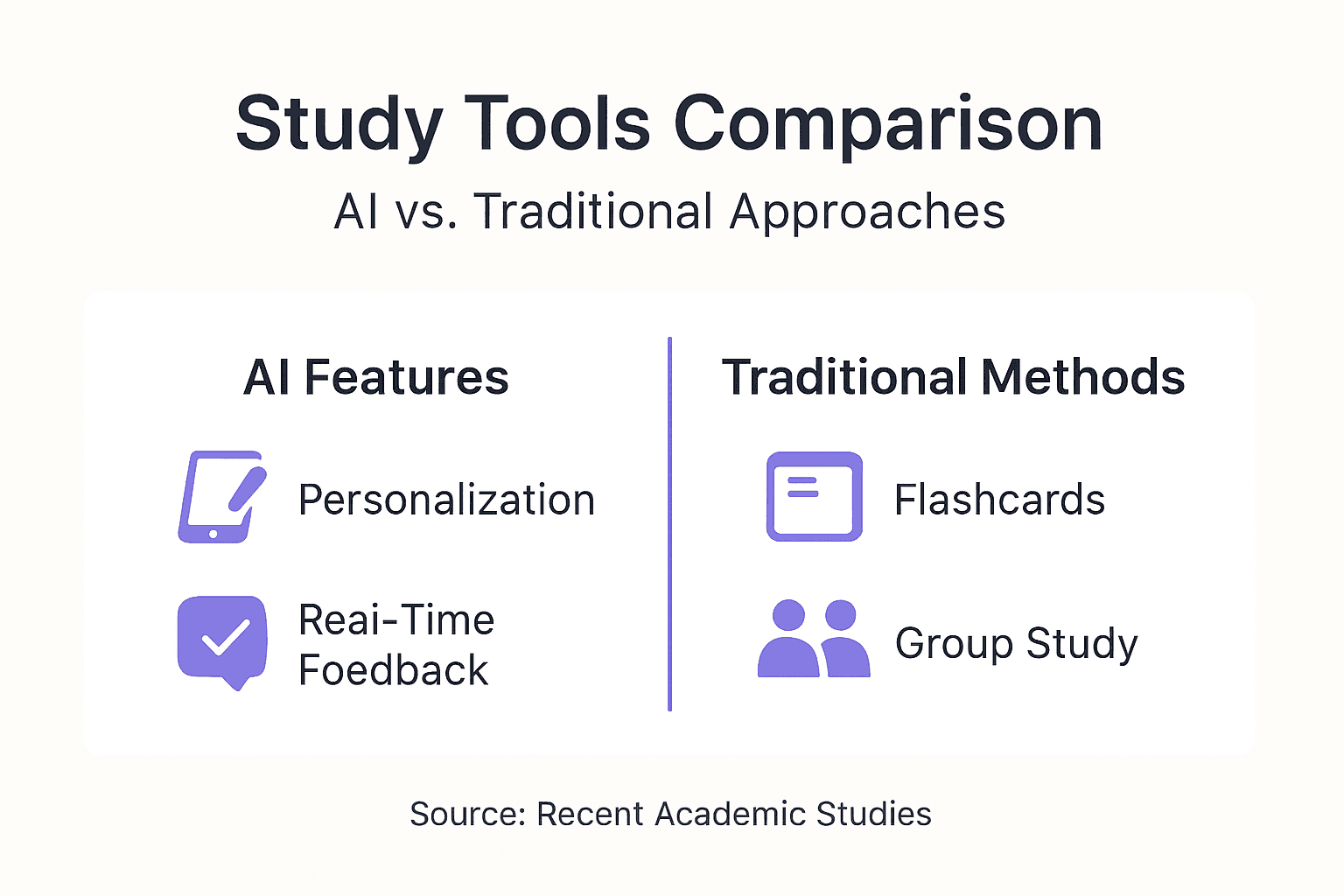
How AI Tools Win on the Metrics That Matter
Compare these directly:
- Personalization: AI adapts to you; textbooks are static
- Feedback timing: AI provides instant correction; traditional methods delay feedback by days
- Time efficiency: AI identifies weak areas automatically; you'd spend hours self-diagnosing
- Retention: Spaced repetition algorithms beat manual review schedules
- Engagement: Interactive quizzes beat passive reading
- Scalability: AI handles unlimited materials; traditional methods struggle with volume
The research confirms this advantage. AI study tools improve GPA and reduce study time compared to traditional approaches. Students using AI tools report completing the same learning outcomes in significantly fewer hours.
Here's a quick comparison of AI study tools versus traditional methods across essential academic metrics:
| Metric | AI Study Tools | Traditional Methods |
|---|---|---|
| Personalization | Adjusts to student needs | Same for every learner |
| Feedback Speed | Instant correction | Delayed, often days |
| Time Efficiency | Automated, saves hours | Manual, labor-intensive |
| Retention | Uses spaced repetition | Relies on self-review |
The Honest Comparison: Where Traditional Methods Still Win
Traditional study isn't obsolete. Group study discussions develop critical thinking in ways AI can't replicate. Hands-on lab work with classmates builds collaboration skills. Face-to-face teaching creates mentorship that algorithms can't replace.
AI tools enhance learning outcomes when combined with traditional approaches rather than replacing them entirely. The best strategy blends both.
Here's the reality: AI excels at repetition, personalization, and feedback. Traditional methods excel at deep discussion, collaboration, and practical application. Neither is superior alone.
The winning approach combines AI's efficiency for foundational learning with traditional methods' strengths in collaborative problem-solving and hands-on application.
Integration challenges exist, though. Not all schools have adopted AI tools yet. Some courses still require traditional study methods exclusively. Understanding how to use both effectively matters more than choosing one.
For science students specifically, AI helps you understand theory faster, freeing time for lab work and group projects where human collaboration shines. You're not choosing between methods; you're stacking them strategically.
Pro tip: Use AI tools to master foundational concepts and memorization quickly, then invest the time you save into group study sessions, office hours, and lab work where human interaction drives deeper understanding.
Boost Your Learning Efficiency with AI-Powered Tools from ArakStudy
Struggling with dense study materials and looking for a smarter way to master complex subjects? The article highlights the challenges of traditional study methods and the need for personalized, adaptive learning that provides instant feedback and real-time content analysis. If you want to transform how you study by harnessing AI-driven features like interactive summaries, adaptive flashcards, and mastery tracking, ArakStudy offers a complete solution designed just for students like you.
Experience how ArakStudy consolidates multiple AI-powered study tools into one intuitive platform so you can cut through information overload and focus on what truly matters. Start saving time, reduce frustration, and improve your exam performance today by visiting ArakStudy’s platform. Take control of your study routine now and explore how interactive learning can make a real difference in your academic success.
Frequently Asked Questions
What are AI-powered study tools?
AI-powered study tools are applications designed to enhance learning by automating repetitive tasks, personalizing content, and providing instant feedback. They use machine learning and natural language processing to analyze course materials and adapt to a student's learning pace.
How do AI study tools improve learning and retention?
AI study tools enhance learning and retention by providing personalized content tailored to individual needs, employing spaced repetition for optimal memory retention, and offering real-time feedback that helps students correct misunderstandings immediately.
What features should I look for in an AI study platform?
Key features to consider include adaptive learning paths, real-time feedback, intelligent flashcard generation, concept mapping, spaced repetition systems, and citation management tools to support efficient learning and enhance academic performance.
What are the potential drawbacks of using AI study tools?
Potential drawbacks include over-reliance on AI, which can weaken critical thinking skills, as well as data privacy concerns when uploading sensitive materials to cloud platforms. It's essential to use AI as a supportive tool rather than a replacement for independent thinking.
Recommended
Related Topics
Try ArakStudy Pro
Experience AI-powered summaries, unlimited flashcards, and concept graphs today. Take your study sessions to the next level.
Start Free Trial